



's latest novel is After This
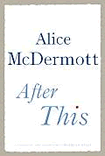

© FSG
She is the author of five other novels, including Child of My Heart,
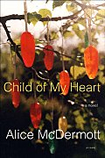

© Picador
Charming Billy, winner of the 1998 National Book Award,

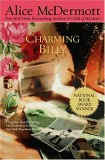
© FSG
At Weddings and Wakes,
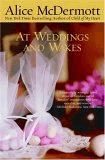

© Delta
That Night,
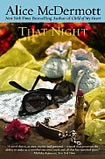

© Dial Press
and A Bigamist's Daughter.
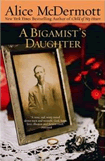

© Dial Press
She lives with her family outside Washington, D.C..

Alice McDermott has earned two Pulitzer Prize nominations, and, for 1998's Charming Billy, a coveted National Book Award. Her latest novel, After This, has been widely praised for its sparing but poignant portrait of a Long Island family's struggles to deal with the death of its eldest son in Vietnam. This isn't new territory, but in her insightful treatment, it seems like a story that's never been told.
For all her success, McDermott is a down-to-earth soccer mom who's always ready with a thoughtful answer to any question about her writing, and writing in general—as she was recently, taking time from her book tour to catch up via email with our special correspondent Julee Newberger.
| * * |
For those who haven't read your new book, let's start with a title clarification: After This… After… what, exactly?
"And after this our exile.” A line from the Catholic prayer that Michael remembers as he drifts to sleep in his college bed...
The opening of After This foreshadows all the book’s major themes: religion, war, loneliness, death, family connections... Did you know from the first sentence where the story was headed, or did you return to the beginning while revising, to add in the foreshadowing effect?
I knew that I wanted the novel to be about family connections, and discovered through the writing that it must then also be about religion (faith, hope and charity, mostly), death, loneliness, happiness, art and—given the decades the book covers—war. I didn’t have to go back and add these ideas to the prose, the prose itself, the writing process (as we sometimes call it) was where I discovered what the book was about.
You are sparing in what you share of the Keanes' family story. For example, you write about their son Jacob's death in Vietnam without detailing the event, or its immediate impact. Rather, you allude to the death, and we are left to use our imaginations to figure out its effects on each family member. Was there a death scene in an earlier draft of the book? How did you decide which scenes to omit and which to include?
No, no death scene earlier in the book. Much depends, in these matters, on intuition: how much does the story, the reader, need—how much can be inferred—how much to say about a grief—the loss of a child—that there are no adequate words for? Just as (think of Msgr. McShane in the last scene) there are no adequate words for those moments when we are overtaken by joy, or a sense of peace. (Keats, “Heard melodies are sweet, but those unheard are sweeter”) I disagree, however, that readers are left to use their imaginations to figure out the effects of Jacob’s death on the family: Annie flees the country, and the family, in order to discover how to live with the loss; Michael is tempted to tell Susan that Jacob is alive and well, teaching school, married, going to become a father (imagining, in other words, a redemption of sorts, the great promise of the faith he thought he had untangled himself from), Mary tells Pauline she will never get over it... Clare offers her family a way into the future with a new life, a reconfiguration of the family that was...
You once admitted that the choosing a novel's "time" and "place" is often a manner of convenience… each being important not in and of itself, but in terms of how it can help you achieve the goals you've set for yourself in writing a given work. Why, then, did you set After This on Long Island?
I began the novel with the idea of family as our first shelter, an island, if you will. The image that John Keane has very early on, of a storm that began with the shudder of another continent eventually tugging at the eaves of his home, the shoreline of his own little spit of land... Long Island as the great post-war incubator of new families... life reconfiguring itself after the war, new little house after new little house, shelters (as Dylan might say) from the storm...
It’s been said that, to some extent, every novelist writes the same book over and over. Many reviewers have noted how much your novels share: middle-class Irish Catholic characters, and that Long Island setting... Do you ever worry that you are indeed writing the same book again and again?
No. I think the question doesn’t apply to fiction... More southerners, Miss Welty? More Russian émigrés, Mr. Nabokov? Have you considered using your imagination, Mr. Garcia Marquez, and maybe setting your next novel in Finland? We’ve forgotten how to read literature (or even what literature is for) if we confuse the meaning of a piece with its subject...
In After This and elsewhere, you manage to treat potentially melodramatic scenarios without lapsing into melodrama. How do you tackle births, deaths, weddings, and wakes without crossing the line into sentimentality? Are there times you feel that you've crossed that line and need to pull back?
I let my characters lead the way. If their emotions and experiences are authentic, even if authentically sentimental or melodramatic, I’m not going to tell them otherwise.
You have a great knack for creating interesting, complex characters based on well-worn character types—Charming Billy's lovable if pitiable alcoholic, and That Night's star-crossed teenage lovers, to cite two examples. What is it about a character that strikes you as being story-worthy?
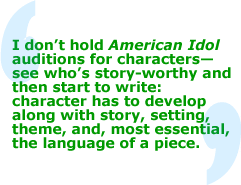
I don’t hold American Idol auditions for characters—see who’s story-worthy and then start to write: character has to develop along with story, setting, theme, and, most essential, the language of a piece.
You’ve told your creative writing students that “if you can do anything else that gives you equal pleasure and allows you to sleep soundly at night, do that instead!” Is there anything else you could do that would allow you to sleep soundly at night? Can you envision a time when you will do that instead of writing?
If I had found such a thing, I would have done it long ago.
In addition to teaching, you also have the responsibility of raising three kids… In light of the above question, do you wonder what life (and your writing) will be like after your kids have grown up and moved out of the house?
I wrote before I had children, I wrote through their infancy and childhood, and now that they’re growing and leaving home, I still write. They’re separate things: your writing life and the life you lead... What bearing one has on the other is not terribly interesting to me. I’ve never been much interested in any author’s biography. It’s the work that matters.
You've described your novels as having a "Catholic décor," because it's what you know, and establishing the religious lives of your characters helps you understand what drives them. Could you write about characters of other faiths, or with no religious beliefs?
”Catholic décor” is Flannery O’Connor’s term. A good one, I think. Again, I can’t imagine setting myself the task of writing about someone without religion, or with a different religion—characters develop out of story and theme and the rhythm of the prose...
In talking about Child of My Heart, your fifth novel, you've said that after 9-11, you felt the need to do something different. Indeed, many said the book represented a departure for you. Do you agree?
Every book feels like a departure to me... the words are always arranged in different patterns, the story always begins as something not yet told, the characters have yet to reveal themselves, the destination has yet to be discovered... Every time you write, it’s a departure into the unknown—if not, why do it?
What books your characters read, and talk about, often tells your reader a great deal about them. When writing, how conscious are you of how you depict a character's relationship to books? And do you ever judge people by the books they read?
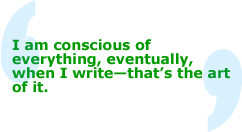
I am conscious of everything, eventually, when I write—that’s the art of it. It’s never even occurred to me to judge people by the books they’ve read—it probably makes more sense to judge books by the people who read them...
Like Faulkner, you've said that you always write your next novel in order to get at what you failed to get at in your last one. What did you hope to achieve in After This that you hadn't achieved in your previous books? And what do you hope to achieve in your next one?
To convey, however briefly, the pain and sweetness of life... that answers both those questions.
© 2006 failbetter LLC · all rights reserved

