
My Vacation with Vanya
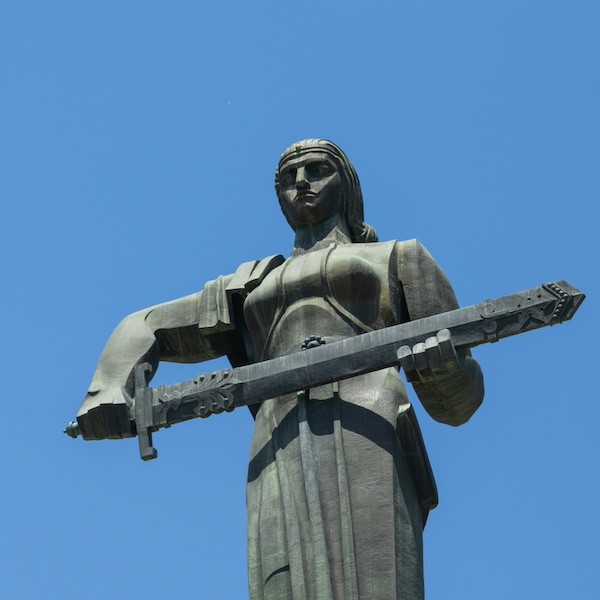
In late September, it’s still hot in Armenia, with temperatures reaching 30 degrees Celsius in the afternoon. At around 2 p.m., Vanya and I usually go outside for lunch. I still wear shorts. The sun burns my legs slightly. Locals don’t wear shorts, and you can instantly distinguish them from tourists or expats, like us. Vanya is an exception, though; he wears jeans all year round, no matter where he is.
On our way to an eatery, we pass a boxing club on the ground floor of our apartment building. Through the large windows, we see boys and girls jumping with their fists clenched, raised to their chins, knocking out invisible opponents.
We walk through a public parking lot. In the center lies a large, bloody rib cage of an unknown animal, still intact after several days.
After the crossroads, we head to the local market, which is located in a massive Soviet-era pavilion made of glass and concrete. Along the facade, on the pavement, are multi-level cages packed with live chickens and rabbits. There are also boxes of fruit, vegetables, herbs, and salads of all kinds. We step over streams of blood flowing from butcher shops and fishmongers. The air is filled with the scents of peaches, apricots, fresh and rotten meat, fresh and rotten fish, chicken shit, and coriander.
We bypass the market building and enter a small kebab shop on the corner. We order a pork kebab and a tarragon lemonade.
We take an alternative route on the way back, just for a change. The streets are dusty. The air is heavy. Gusts of wind often lift sand, forcing us to cover our eyes. Tall, old Oriental sycamore trees tower over the sidewalks, casting large shadows. However, it’s best not to linger there: flocks of crows sit on the trees and shit everywhere. Stray dogs lie around looking for scraps.
On our way home, we stop at a grocery store to pick up some beer and wine.
In the evening, after work, we have a drink and watch the local news. It's also about the war and mobilization, but it's in Armenian, which we don't understand. This makes it easier for us to feel a bit more detached. We leave a balcony door open to let in some air. It’s still light outside. We step out onto the balcony and take in the view of Yerevan from our sixteenth-floor apartment. From this point, the city looks mostly gray, consisting of large-panel residential buildings from the USSR era and dusty shacks. As it grows darker, Mount Aragats gradually turns black on the right. The city hums with the blare of car horns, roaring engines, screeching tires, Armenian speech and screams.
Fueled by booze, the conversation inevitably turns to politics. We occasionally argue. Although Vanya ended up in Yerevan to avoid being mobilized, he generally supports Putin and his decisions. He is convinced that anti-war people don’t understand “the whole complexity of the situation.” I don’t want to delve into that “complexity,” so I usually suggest switching to a more neutral topic.
We booked our current two-bedroom Airbnb apartment for two weeks at a cost of $700. Our plan is to find a place to stay for at least six months. But that’s problematic. Rent prices have skyrocketed and are now comparable to those in Western European capitals. Locals say this is because of the second wave of Russian expatriates. Those who arrived in March paid half as much. Real estate agents usually offer us one-bedroom apartments on the outskirts for $800–$1,000. In the city center, prices start at $1,200.
This second wave of expats is primarily male. At the Russian border control, everyone flying from Russia these days was asked the same question: “What’s the purpose of your trip?” “Vacation,” everyone answered. There was no hint of a smile on the other side of the glass. The officer’s face was as sour and impenetrable as always. After a few seconds of oppressive silence, we heard the shutter-like sound of the stamp.
And here we are, on vacation, so to speak.
We don’t yet despair about our dwelling. The novelty of the place, not to mention the cheap food and alcohol, helps us stay positive. So far, we also have our remote jobs.
Over the weekend, we walk around the city center. Most of the buildings are brownish-red because they are made of tuff, a volcanic stone. Some houses are made of black tuff and look as if they were burned down and then reoccupied without being repaired.
Some people call Yerevan “The Pink City,” but from the heights of the Cascade Complex, it looks pale brown with a violet haze hanging above. Without the Ararat silhouette in the background and the absence of mosques, you might think you were somewhere in the Middle East—especially if you’ve never been there.
Vanya’s wife couldn't join him; my girlfriend refused. We look at local women with particular interest. Armenian women are generally pretty. However, many of them have plastic surgery on their noses and look similarly uncertain. We’ve noticed some with implausible noses that look like one of Michael Jackson’s early nose jobs. Vanya is sure they visited the same surgeon who is a fan of Jackson.
People don’t seem hostile or friendly. It’s rare to encounter someone who doesn’t speak Russian. However, we sometimes notice contemptuous looks, mostly from young waiters and cashiers. To be more polite, we memorized “barev dzes,” which means “hello,” and “merci,” which means “thank you.” The latter sounds like it’s French, though.
We don’t know much about the politics between Armenia and Russia, except that they’re complicated. We’re unsure whether the Armenian authorities would deport us if the Russian authorities requested it.
Today, my colleague in Yerevan introduced us to a real estate agent and recommended him as the best in the field. This agent had previously helped my colleague. The agent has a Russian name, Nikolay, but he speaks Russian with a strong Armenian accent. He promises to find us an apartment in a few days. We feel relieved. Vanya offers to celebrate with some Armenian red wine.
We’ve gone through three bottles. I uncork the fourth. The conversation turns to the war. Vanya starts talking again about how right Putin was to kick it off and how the US and NATO provoked him. At the same time, he thinks the Russian command is a gang of idiots and that the army is a mess. He doesn’t want to be annihilated by a HIMARS shell in a trench because of someone’s idiocy.
When the bottle is almost empty, we head out to the balcony. A light, warm wind blows in our faces. Vanya starts complaining about his job, which has been tougher than usual lately. He has to take on many of his ex-colleague’s tasks who recently died. Vanya is upset about his unexpected death. His colleague left behind a wife and two children. “She is a very, very good woman,” says Vanya. But the colleague wasn’t nice to her. He had affairs. Vanya starts deriding the dead man, but for another reason: “Now I need to clean up a lot of his silly code!”
Vanya is plastered. He turns to politics again. He calls me a Fifth Column. He playfully punches my belly and sides. “Come on, Fifth Column, come on,” he mumbles. His punches become less playful. He weighs about 10 kg more than I do. I ask him to stop. He ignores me. My wine spills on the floor. I ask him again, this time louder. He continues, giggling. I set the glass down on the table, turn around, and throw a right hook to his midsection. He slowly bends over and sits down. He lies curled up and moans. I apologize. I lean over and gently slap his hips. He just moans. I pick up the wine and continue drinking while looking at the city. A minute later, Vanya slowly gets up, goes to his bedroom, and closes the door.
When I return to the living room, I pour the remaining wine into my glass. I notice many unread messages from Polina on Telegram. She explains why she decided not to join me after all. She didn’t want to put herself in another uncertain and probably miserable situation like the one in Georgia in March. She is tired of being a runaway. She is tired of being a ‘stumrebi’. She is also surprised by my weakness and my willingness to avoid any problem in life by simply borrowing money and flying to any shithole that doesn’t require a visa. Most importantly, she adds, I don’t even consider her view on the current situation with the war. Her thoughts. Her feelings. Or her plans. She thinks I don’t care about her. I reflect on her words. I close Telegram and go to the Meduza site to read the news about the war. A minute later, I open Tinder and start senselessly swiping left and right.
Nikolay’s call wakes me up at 9 a.m. I’m still drunk and have a pounding headache. He suggests that we get up quickly, take a taxi, and drive to see a three-room apartment in the Nor Arabkir district. We have to hurry before someone else grabs it. “It’s not bad,” he adds. I don’t know anything about Nor Arabkir. I ask him where it is. “Not so far from the city center,” he replies. “I’ve sent you the location on WhatsApp.”
I wake Vanya up and ask him how his stomach feels. He touches his right side and says, “Probably a rib is broken. I need to see a doctor and get an X-ray.” I tell him that we’ll definitely do that, but later. Right now, we need to look at the apartment. I have a good feeling about it. Vanya starts to get up, moaning.
The taxi ride takes 20 minutes. The landlord’s agent is still on his way. We decide to walk around and look at the area. The block consists of five-story residential buildings, some of which are large-panel and some of which are made of tuff stone. The area is lively and loud. People scurry around and scream; cars rev and honk. There are many small shops selling everything you need: meat, fish, fruit, vegetables, alcohol, phones, hardware, and so on. We buy disgusting coffee from a booth and drink it eagerly.
Finally, we enter the apartment. The hallway is narrow, like a wormhole. On the right is the bathroom, which looks like it hasn’t been cleaned in years. Vanya checks to see if the faucet works; it coughs and spits water as if it has bronchitis. In the cramped kitchen, which is splattered with oil and other substances, we can’t pass each other without hugging. Then, we find ourselves in the living room furnished with a table, a chest, and a couch that are at least thirty years old. A light bulb without a shade dimly illuminates the room. There are no windows, only two doors on the left and right. These doors lead to tiny bedrooms, each of which is fully occupied by a child-sized bed. At least these bedrooms have narrow windows. Looking outside, I see the familiar view of large-panel buildings. Vanya whispers that it looks like nobody has lived in the apartment for decades. He thinks the last tenants either died or disappeared under mysterious circumstances. The landlord’s agent asks us what we think. I ask him how much it costs. “Just eight hundred and fifty bucks”. We thank him and leave.
I call Nikolay to ask if he has seen this hovel. He replies that it looked pretty nice in the photos. I tell him to find us something else that is at least lighter and cleaner. I add that we are willing to pay more if necessary.
An X-ray reveals that Vanya’s ribs are fine; it’s just a contusion. To celebrate, we buy some Kilikia beer. Vanya chuckles and begs me not to beat him.
We spend several days rushing around the city to explore Nikolay’s options. We’re almost abandoning our jobs and praying that we won’t be fired. Most of the apartments we see are in the same condition as the one in Nor Arabkir and are located on the outskirts. Others are ridiculously expensive.
A cold night. We’ve made it to the park near Saint Gregory’s Cathedral. We’re sitting on a bench in a workout area, drinking beer and talking. We’re both horny. I confess to Vanya that I’ve been looking for prostitutes. There are plenty of them on Tinder. However, they cost twice as much as they do in Saint Petersburg, and they won’t negotiate. Vanya is outraged. “Anyway,” he adds, “I won’t be able to use this option.” He texts his wife, Anzhela, asking for nude photos of her so that he can “jerk off in good conscience.” I wonder if he could share one of her photos with me. “Fuck off,” he answers. Anzhela refuses him and recommends that he stop drinking and go to sleep. A man enters the workout area. He approaches the horizontal bar, jumps up, and hangs from it. Some extremely fast beats are coming from his headphones. After doing fifteen pull-overs, groaning loudly, he jumps down and leaves. Vanya gets up and heads to the nearest bushes to piss. I’m thinking about contacting Karine, an old Armenian friend of mine from Moscow. She spent her early childhood in Yerevan, so she might know people renting out apartments. The problem is that I haven’t seen or spoken to her in about eight years. The last time I saw her was in Saint Petersburg. She was on a solo vacation, taking a break from her family—a toddler and a cheating husband. We sat on the Palace Embankment near Troitskiy Bridge, discussing whether to go to her hotel room. Her cheeks were burning. She decided not to. I don’t know if she thinks about me now or even remembers me. When Vanya returns, I share my thoughts and concerns about contacting Karine. “Just text her and ask,” he says. “I can’t,” I say.
We order a taxi. After some small talk, the conversation quickly turns to the most vital subject: our failure to find a place to live. “My friends, I’ll tell you this,” the driver says. “It’s a wild, crazy situation. But the main reason is not you, Russians who fled here. The main reason is us, Armenians. We just love money very much. Did you know that many people with apartments in Yerevan are moving out to live with their parents or grandparents? Why? To rent their apartments to you! The average Yerevanian makes five hundred dollars a month. For them, getting an extra thousand dollars from the rent is like manna from heaven. Some have even evicted their longtime local tenants, who suddenly had to pay five times more. Almost no one can afford that. “Now, imagine,” the taxi driver says louder. “How are locals supposed to rent a dwelling here in such a situation, let alone beggar refugees from Artsakh? It’s just impossible! For you, it is. So, cheer up. You’ll get what you want sooner or later.” After the taxi drives away, Vanya says the speech wasn’t very encouraging, despite his intentions.
We see a nice, two-room apartment in the city center, near the National Theater. Compared to what we’ve seen before, it’s like a palace. It’s only $1000 per month. We’re sitting on a leather sofa in a spacious living room. Gevorg and Ophelia, the landlords, sit in armchairs in front of us. They are an exemplary couple in their forties who exude dignity. Gevorg is a surgeon. Ophelia works at the Armenian branch of the UN. They are very polite, smiling, and inquiring about our jobs. We tell them that we work for IT companies. That’s enough for them. Gevorg says, “I see that you are reliable young men. You will be second on our candidate list.” They both laugh. Gevorg pulls out his phone and asks if we’ve seen the meme about the current real estate situation. He shows us an image of three vampires dressed like Musketeers, looking straight and arrogant. The caption reads, “The March expatriates look at the September ones.” Gevorg and Ophelia burst out laughing. “Nice one,” Vanya says, smiling. “Indeed,” I add, smiling too.
The next day, Gevorg sends me a voice message. “Hello, Sergey-djan. How are you? Unfortunately, we chose the guys who were first on our candidate list. Anyway, best of luck with your search. Say hi to Vanya.” It seems like he was smiling while recording this. I put my phone down, and then I see Karine’s message pop up on my lock screen. She’s asking me how I am and where I am. I call her to respond. She says that when the mobilization was announced, she immediately thought of me. I explain our situation to her. She asks me why I didn’t call her when I arrived in Yerevan. I reply that I didn’t dare.
In two days, we rent a cozy one-bedroom apartment in the city center near English Park with a balcony view of Mount Ararat. It costs us just $800.
The apartment’s owner is a client of Davit, a real estate agent and nephew of Tigran. Tigran has been a client of Karine’s for a long time at the Moscow bank where she works. After signing the rental agreement and bidding us a pleasant stay for the next six months, the landlord leaves. I rejoice and jump like a schoolboy. Vanya just smiles, which seems a bit strange to me. I call Karine to thank her, showering her with every kind word I can think of. I offer Vanya to celebrate this incredible occasion. He offers to invite Davit, the real estate agent, who seems like a nice guy.
We are at the Dargett Bar, enjoying some craft beer. Davit is several years younger than us and speaks Russian with some difficulties; we switch to English from time to time. We praise the beer, admitting that we haven’t tasted such a delicious ale in a long time. Davit is happy about that as if it was his own brewery. He tells us he will pay for this evening because it is the tradition, and any objection won’t be accepted. We bombard him with questions about Armenia: its traditions, politics, history, crime, and the people. He shows us photos from a recent wedding he attended. “A typical Armenian wedding has from 200 to 300 guests,” he says proudly. In one photo, Davit is surrounded by men of all ages sitting behind long tables piled high with food. Each man wears a white shirt and a white T-shirt underneath. We then move on to Armenian women. Davit tells us that they like to buy luxury stuff, such as the latest iPhone or a Chanel handbag, on credit, even though they commit to their low-paid work on a packed minibus. An Armenian woman can marry a man of another nationality if there is true love involved. Locals can live with their parents until they are thirty or even older. Davit hates faggots and has punched one in the face. Moscow Armenians aren’t really Armenian; they’re just jerks. True Armenians, however, don’t think about the future; they live one day at a time. Many of them gamble. Davit did, too. He’s glad he’s not allowed to take out another bank loan. Vanya asks about the war with Azerbaijan. Davit sighs heavily. “Here’s what I’ll tell you, Vanya-djan…” He has many friends who were injured or killed. An Azerbaijani sniper shot his cousin in the neck, leaving him disabled. The Armenians didn’t have enough weapons. The Azerbaijanis used phosphorus shells and shot at random. The main Azerbaijani hero is the man who killed a sleeping Armenian officer at a NATO training camp. Davit pulls out his phone and tries to show us what Azerbaijani soldiers did to a female Armenian soldier they captured during the last war. We look away and beg him not to show us. “Can you imagine,” he says, “What kind of people are we fighting?” Davit doesn’t sympathize with Ukraine because it supported Azerbaijan with weapons. He thinks Zelensky is overstepping his bounds. I wave to the waiter to order our sixth round of beers. To change the topic, I ask Davit if he has ever thought about moving, like many Armenians do. He says he was born here, and he will die here.
When I wake up, I see that the balcony door is open. It’s unbearably bright outside. It’s only 9 a.m., and Vanya is standing on the balcony looking at Ararat. He turns around. When he notices that I’m looking at him, he lowers his eyes. I ask him what happened.
“I need to go back,” he replies.
“Where? To the bar?”
“No, to Russia.”
“What?! You’re joking, right?”
“I’m not.”
“Why?”
“Anzhela can’t manage it alone, with two kids, and her father is relapsing.”
“Fuck… We just got this nice place, and now you’re slipping away.”
“Sorry, man. I thought about it for a while. Finally decided this morning. Don’t worry, I’ll pay my share of the rent for the next six months.”
“Thanks, bro… But the mobilization continues. And you are an officer in the reserve. Have you forgotten? They’ll grab you and throw you into the trenches. Like they did with Martyn.”
“It’s possible. But I hope the postponement for IT workers will help.”
“People say it doesn’t really work.”
“Anyway, I don’t have any other options.”
The next day, Vanya leaves and returns an hour later with a large khaki backpack. I asked him if he bought it for comic reasons. He didn’t. He’s serious. “If they grab me, I’ll be partially prepared, at least,” he says. He opens the backpack and pulls out a plastic bag with six peaches. “A fairing,” he explains.
Vanya is flying away in the evening. We drink beer and watch videos on YouTube. There’s one about a queer Yakuza and another about a guy who visited the worst strip club in Los Angeles. Then, we watch 4K videos of Yerevan and Batumi, where the authors stroll through the cities. Then, the taxi driver calls to say that he has arrived. I help Vanya carry his khaki backpack and suitcase to the taxi. I drive with him to the airport. After we hug, Vanya goes to border control. When I get back home, I open a bottle of wine and continue watching the 4K video about Batumi.
A few days have passed. One night, after getting drunk, I saw Vanya’s funeral. He was buried in a closed coffin because he had been blown into pieces by a HIMARS shell. Thousands of people gathered for the funeral at the Armenian Market. Among them were Nikolay, Gevorg, Ophelia, Davit, and Karine. Everyone cried except for Gevorg and Ophelia, who chuckled. Davit gave a speech, saying that Vanya-djan was a real hero and also wrote exemplary clean code. Moans and groans grew louder. Then, Davit turned to me and said that I should change the lock on my apartment door because the landlord might be a thief. He added that even if God came down, Armenians and Azerbaijanis would never be friends. Then he burst into tears. Gevorg and Ophelia laughed. Nikolay whispered something to Karine, pointing at me. I woke up in horror. It was only 5 a.m., but I immediately texted Vanya to ask if he was alive. He confirmed it three hours later. I promised to celebrate with Kilikia beer.