
Saint, Sinner
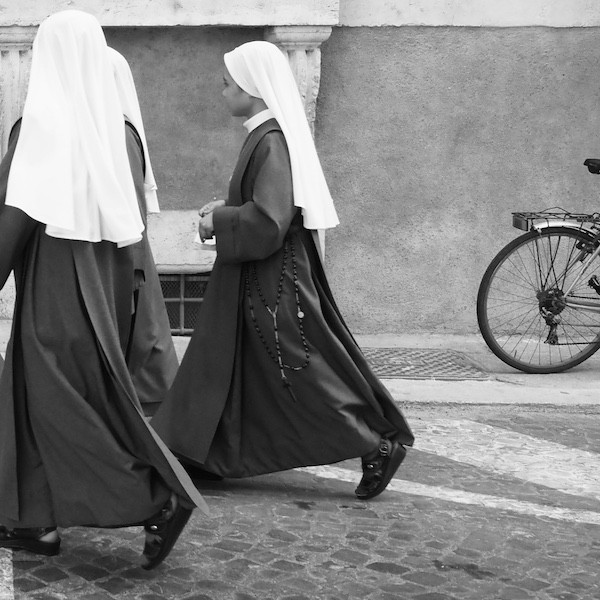
Years later, when asked why, she replied, “I never thought of myself as a pretty girl.” This was the truest thing she has ever said, or complete and utter nonsense of the most unforgivable kind (the kind that reflects mock self-loathing); you could not tell. For this reason you had to listen to the rest of the story.
At thirteen, Deb joined the Sisters of St. Francis of Sylvania, Ohio. Her biographers1 would later attribute this occasion as the start of her liberalism (after all, Saint Francis held the honorific position as the most radical Catholic, and certainly the most beloved among feminists, tree-huggers, vegetarians, and spiritual members of PETA, at least until the latest Pope—coincidentally also named Francis—came along and declared global warming to be the biggest problem facing the church since Jesus). Unlike other youth of her generation who picked up liberalism on New Year’s Eve, 1959, and wore it for decade until it wore out, Deb held on to hers for the remainder of her long and overdrawn life like a miraculous coat of arms whose seams never loosened with age or weather.
At thirteen, Deb was the youngest member of the Franciscan Sisters. Between her and the octogenarians who ran the place dwelled an immense gap in years that would later be filled with living and dead husbands, canned tuna casseroles, and doubt over the nature of God. Her first real surprise upon arriving was the largess that was—indeed, defined—the headmaster of the bunch. She had always assumed nuns to be small, sickly things, modest in their thin, hunched frames, wearing their asceticism on their trim, minimalist faces, bearing asexual names like Sharon or Marguerite or Lenore. The congregational minister, inappropriately named Jennifer of all things, and worse, Jenna for short (or Jenn, but only if you were in a hurry), carried an even more inappropriate figure, one of almost infinite bounty. Deb wondered—only for a moment—if perhaps Jenn/Jennifer/Jenna was an emotional eater, filling the vast under-explored terrain of her vagina with Twinkles or biscuits or whatever it was nuns ate. “I’m very pleased to be here,” she announced in a grave voice, trying to sound older than she was. “Terrifically happy.”
“In Europe, theology is enough for the ministerial needs of those who dedicate themselves to the grace of God,” Sister Jenna answered, equally gravely. “But here, we have no real interest in quibbling over spiritual interpretation. We are more interested in forever changing lives. Anything less is failure.”
Deb wondered if Jenn had ever been to Europe (she hadn’t; she was born and raised in Sandusky, Ohio, which bears no relation to Jerry Sandusky, the former Penn State coach charged with fifty-one counts of pedophilia, and only briefly considered changing its name to Sandy or Dusky or SD, Ohio for short in 2012 amid the height of the trial). She assumed correctly not to ask, and instead, inquired about the hospice ministry.
“I was thinking of helping the hospital chaplains,” she announced.
“Who, Sister Pamela?”
Deb wanted to ask if all the Sisters were named after porn stars. She refrained. “Do you know her?” she asked instead. It was a stupid question, she decided, but not as stupid as what she was really thinking.
“She runs a small visitation program in the nursing home; she visits two of the hospitals, but only on occasion. Has she agreed to do it?”
“Not yet,” Deb admitted.
Step One in becoming a Sister was pre-candidacy, then candidacy, Step Two. Step Three—Novitiate—came at least two years later, after the hazing and the daily judgment (but in certain cases, took as long as three or four, depending on whether there was any surprises involved—in this case, all surprises took the form of an untidy penis, typically delivered by a former lover but occasionally—and even worse—by a congregant). With Novice status came the coveted formality of being called “Sister.” Another two years later came the First Commitment, which is sort of like the Second—i.e., Permanent Commitment—except that you could back out at anytime, which also made you wonder about how the Catholic Church defined commitment. Perhaps that was why so many Catholics were divorced, you gathered.
At eighteen, Deb changed her mind and enrolled at UC Santa Barbara. Thin but with a terrific rack and small under-butt, she quickly found an undeclared major to marry and the two of them acquired a small loft in Family Student Housing. This was the sixties, when getting married and getting an education were not mutually exclusive. She was well into her senior year when she gave birth to her first son, Joseph, and married her second husband, a pre-med turned business major with a penchant for tacos.
By the time of her second divorce, Deb had acquired three more children: Luck, Nick, and an adopted boy from Sinaloa, Mexico that she named Ben.
The year following her divorce, Deb signed up for the Catholic Worker in East Los Angeles with a handful of other ex-nuns who had faded from liturgy but missed the activism. Their goal? “To comfort the afflicted and afflict the comfortable,” they said, because martyrdom was still fashionable.
To this end, Deb and her three younger boys moved into the Hennacy House, a persimmon colored Victorian in Boyle Heights, next to the Homeboy Bakery and Hippie Kitchen, with checkered floors and doors that never closed, plus an ever-rotating roster of wanderlusts that nuns managed to scavenge from Skid Row. The four of them took the corner bedroom on the third floor; Luck, Nick and Ben inherited the king-sized bed while Deb, on nights she slept at all, took to the futon.
The trek to Bridge Street Elementary was five and a half blocks and included walking over the 5 Freeway along State street; on these corners, the cross-walks were barren without translucent-bodied men that lit up to guide your step and tell you to halt, or go. That first day of school, the boys learned that dog meant someone upon which you can rely and firme was the Spanish version of awesome. To illustrate, “Dog, does your mom pack you some of them Oreos?” and “those cookies be firme.” The niceties ended when Luck retrieved a bologna and Kraft sandwich from his paper bag lunch, along with a Ziploc of corn flakes, half of which were already pulverized from the journey.
“I thought you were rich,” Oreo boy said.
Luck sat on the galvanized metal bench. “We never said that,” he murmured.
“Okay,” Oreo replied, turning to Nick. “What you got?”
“Same mom, same lunch, dumbface,” Nick said.
Oreo looked surprised. “What’d they call you?” he asked.
“Two Bear,” said Nick.
“What’s that mean?”
“You killed one bear?” Nick asked. A pause. “I killed two bear.”
Oreo laughed. The next day, they were not so lucky.
~
Oreo’s real name, it turns out, was Lefty. The following morning his apparent mother dropped him off late at the playground with his two sisters. She was squinting, or both her eyes were closed; the lids on them were puffed liked newly leavened dough.
“What’s up with your moms?” Ben asked, having passed for brown enough the previous day to not attract much attention.
“I thought you were cool,” Lefty surprised him by replying.
Ben didn’t move.
“My father, I love him but I’d kill him,” Lefty said. “If he ever did that to my moms again. But you?” He looked at Ben again, betrayed. “I don’t even know you.”
Ben regarded him closely, still puzzled.
“Imagine what I’d do to you,” the boy said.
~
No one had to do much imagining, because the revelation came at lunch.
“What’dya going to do to me?” Ben asked, walking up behind Lefty. He didn’t mean it as a threat.
“Well, if you’re going to ask for it,” Lefty said, turning around.
Suddenly there was a knife pointed a Ben. A paring knife, for skinning mangoes before adding chile and limón. Equally suddenly, Ben was off, dashing over the cracked concrete floors before his brothers had time to turn and follow. Lefty was off too, calling out “¡Échale!” as he tackled Ben from behind. Ben called out something too, but in his native Quechuan tongue, something that sounded like tee-tee or ta-tai or titty. Because of all the yelling, Nick and Luck knew that Lefty had not succeeded in killing their brother.
The blade had penetrated Ben’s lower back, two inches to the right of his spine. The ER doctors deemed it, “a non-life threatening injury,” unaware of the social context that would cast doubt on the prognosis.
Deb, for her part, cried and cried. She had just come from the transfusion room at Little Company of Mary Hospital, where one of her homeless buddies, Cliff, was getting his AIDS medication. Drip drip, drip drip. Cliff lived on the second floor of Hennacy, where he gave free (bad) haircuts to the other tenants and talked about his former life in Venice, before middle-aged tech CEOs started showing up at coffee houses with their new Converse shoes and old pick-up lines. Earlier that week, Cliff had fallen in the kitchen while holding one of those glass Mexican coke bottles; the bottle shattered and Cliff, still doped on AZT, sliced his feet on the mosaic of coke glass decorating the ceramic floor. Deb ran downstairs and saw Cliff’s blood all over the black and white tiles; she called all three of her boys to come, stat. “Bring all the toilet paper in the house,” she hollered. Luck, Nick and Ben moped the crimson puddles with 1-ply tissues and bare, grubby, hands while Deb held Cliff’s fingers and fed him a Twinkie, to help with the blood loss. Afterwards, she looked at her sons briefly before saying, “Now go wash your hands before touching yourself.”
This time, it was unclear whether she was crying for Ben’s “non-life threatening injury,” crying from relief that he didn’t die, and wasn’t paralyzed, crying for Cliff’s AIDS or crying for the boy who did this to her son. The next day LA Unified School District sent in a dozen therapists to talk to the children of Bridge Street Elementary for the purposes of clarifying whether what had just happened was merely bad manners or sign that the kids were not alright and on the verge of some large collapse. In this sense, decay, like AIDS, was a strange condition; if you left it alone you could be totally unaware of its influence, but once identified, you can’t help but notice their still small limbs breaking through to slice the living from the dead.
~
1Deb was not famous, at least outside out the nouveau riche community of elderly White Santa Barbara-ians, typically without children, who wearied of their noble and bland origins and devoted their lives to mindfulness or social justice (but never both), for whom Deb became their patron saint. Biographies have been written about less (see: Axl Rose2, President Taft3, the Koch Brothers4, and Leslie Hough5.)
2 The formerly magnetic lead musician of Guns n’ Roses who spent $13 million producing an album he never released. 3 The president you never heard of that came between Theo and Woodrow. 4 Two brothers that could be Donald Trump if they were a tad bit richer. 5 Creator of Splenda.