
Nowhere on a Screen
Hector watched April suck down a Marlboro under The Strand movie theater’s yellow marquee dotted in scorched-black bulbs. Her pale face shot smoke through a black hoodie. Hector snuck across salt-sick Superior Street. The filthy Michigan streets needed a blanket of snow. It would soon baptize everyone: his worn-thin teachers, snow plow drivers, hibernating farmers.
He crept toward her, heard her snort. She was probably still thinking about her asshole dad who’d tried to ground her, tried to keep her in their home served with an eviction notice for next month. Fuck dads. They needed dads like the road needed more salt packed into its chalky cracks. A fractional family worked just fine. It was easier to love in smaller pieces. From behind her, he slipped one hand over her mouth.
“Scream and I’ll kill you, lady.”
A salt truck chuffed by on Superior then an unlit ambulance. She turned toward him, unamused, and blew smoke into his face. “I’m an icicle. Let’s go inside.”
April flicked her butt toward the street. It erupted into a flower of sparks against the side of a white Church of God bus carrying no followers, only a lonely driver headed nowhere. Hector trailed April into The Strand’s lobby.
The lobby was empty. No ticket seller. Sickly yellow lights glazed the glass cases stocked with three-year-old boxes of Raisinets and Snocaps and Junior Mints. Three years of summers were trapped in those petrified boxes—stashed in cardboard, under glass, entombed.
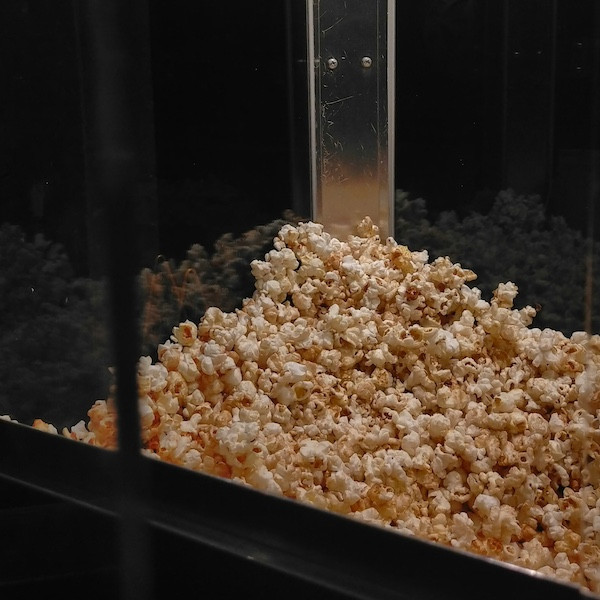
April lifted herself onto the concession counter glass, swung her legs over to the employee side. She scooped popcorn in bare fistfuls down the zippered neck of her hoodie until her belly bulged.
They walked arm in arm down the aisle, into the empty theater’s dark. The giant screen erupted its moonrise. Giant eyes, lips, skirt and thigh. A blue iris big as April’s dad’s gut. Movie stars blazed as bright as starlight. Hector had liked that lesson in science class, how starlight took thousands of light years to reach your eye, and at that point the star could be long dead, a suicidal supernova. Just like this movie, some teen rom-com released in the summer, now playing six months late at The Strand. This was stale life, flickeringly fake, and any of the actors could be dead, all of them could be.
They sank into the front-row seats. The screen was full of kissing. Violin notes choked through the tinny speakers. April tossed handfuls of popcorn above them, made a hailstorm of kernels. The screen flashed prom-dress-cherry-red against her throat. He wanted to kiss it, bite it, lick it.
“What are you looking at?” She chucked popcorn into his face. “Fucking pervert. Watch the movie.”
“Let’s get out of here.”
“There’s nowhere to go.”
“This is nowhere,” Hector said. “The people who work here can’t even stick around.”
“I like nowhere. It’s quiet here.”
Some pop song started up. A shiny blue convertible crested a hill. It snailed into a parking lot filled with more impossibly shiny cars. In the movies, not a single bug ever smeared across a windshield.
“Where would you rather be?” April said.
“We could go to my place. Mom’s probably working. Hell, even your house beats this,” he said.
“I can’t see my dad right now. He’s on a rampage after finding our stash.” It was only an eighth of pot, a few hits of acid. His mom would barely care, just flush it and slap him and then hurry off to work at the old folk’s home.
“At least your dad cares,” he said.
“Maybe he’ll adopt you.”
“He’s around. That’s something.”
“Showing up’s enough?” April said. “That’s bullshit.”
Hector grabbed her hand, slick with popcorn butter and gritty with salt. She looked away from the screen, down at their knuckles. “I’m sorry. I shouldn’t have said that. Both our dads are assholes. Probably all dads,” she said.
He looked back to the screen and then regretted giving those plastic dead-star faces attention. He hated them. They would be disgusted by him and his cold, little Michigan town, his always-working mom and subsidized apartment. “You bitch about your mildly disappointing father, but you don’t really know shit about it.”
“I’m trying to be nice. Jesus.” She gazed back at the screen, at giant sucking lips, eyelashes big and black as midnight branches.
“I don’t want nice,” Hector said.
“What do you want?” she asked, and he could’ve said he just wanted for his mom to be happy, that for April, too. He just wanted the people he loved to stay and be happy in this town that wasn’t so terrible that it required escaping. He wished his father had left a letter explaining why he left when he was a kid: because Hector had been too small, too skinny, cried too easily. Because Hector’s mother had not loved him enough. Because Alma was too cold, too poor, too small. Because somewhere else he might grow a face big as a movie screen and drive a polished car to a pop-music soundtrack. Hector wished his father had documented excuses so he could hate him more accurately.
The movie played on like a silence.
“When they evict us,” April said, “we’re so fucked.”
Hector looked up from her neck to see what April was seeing. Those smooth-skinned, technicolor teenagers on the screen were now shuffling into their vinyl-sided, two-story homes in a suburban utopia.
“What if you could go anywhere?” he asked
“I’d go anywhere else.”
“Like here, where the movies live.” Hector hacked up phlegm, spat at the screen. “Look, it’s sunny and everyone’s beautiful and there’s a million ways to make the same happy ending.”
“Sure. I’ll go there.” April stretched out her legs, smiled.
“That’s nowhere-ist of all. California isn’t even real.” His face was getting hot. In this town, caught in its winter, it always felt impossible to be hot again, but here came the surge of blood.
“I know movies aren’t real,” April said. “I’m not stupid. I just want away.”
Back on the screen, some quarterback-type who looked like he was nearing thirty was at that moment falling in love with the unpopular, rowdy, tube-top-wearing sister of the cheerleader. She was dancing on a table and he was squeezing out a realization. It was a look the movies spent a hundred years perfecting—suddenly realized love furrowing the brow, curling the lips, swaying the chin left and right. April raised both middle fingers at the screen. Hector loved her for hating scripted lies.
“Okay, so where would you go,” she asked, “if you could go anywhere?”
“Where you are.”
“That’s fucking cheesy. Try again,” she said.
“I like our town.” And this seat in their town next to this girl freshly stung by her own father, waiting to lose her home.
“Then you’re stupid,” she said, and leaned her head against his, her frizzy hair tickling his nose, apple shampoo. He closed his eyes to erase the glow of credits rolling, ghostly text skidding up into the ether where no one would ever read.